Thursday, March 17, 2011

THE SUMMER OF GREEN HERONS
PART 1: HAPPY BIRTHDAY!


I was slouched down in my kayak, staring at a branch, when something seeped into my consciousness. Gradually materializing from the tangle of willow leaves was a large, rough nest about a foot across. It was a loose arrangement of twigs that resembled a flat plate.

I paddled under the overhanging branches and did what one must never do––I stood up in my kayak. That took every bit of concentration and nerve I could muster, but it was worth the risk. On that flat nest were 5 lovely blue eggs. (Some books describe these eggs as green or yellow. These were robin's egg blue.) All summer we’d been having hurricane force winds. How on earth do eggs stay on a flat surface when branches are whipping around in the air?

Given the threatening squawks coming from a nearby tree, it was clear that these eggs belonged to that really agitated Green Heron mom. I hurried home to read about Green Herons, a common bird that I had never seen before. Green Herons build nests on branches that hang out over water, a dream come true for someone with a camera and a boat. And as near as I could calculate, those eggs were due to hatch––drat!––while I was in Michigan.

For three and a half weeks I watched those eggs like Dr. Seuss’s Horton, then my husband stuffed me kicking and hollering into the car to head for Michigan. Four days later when we returned, the instant the car rolled to stop, I jumped out, ran down the hill, and paddled across the pond.

 What a relief to see the nest still sitting on its tenuous perch. I stood up about 4 feet away and was thrilled to see the eggs were safe and lovely as ever.

The next day, the eggs hatched. Some days it’s hard to deny your extreme good fortune. In the morning, a tiny hole appeared in one egg. By noon, it was a crack. By suppertime, a tiny, gnarly yellow foot popped out. My life was complete. We’d both had a long day, so I ran home, gulped supper, and returned to the nest. The first-born was splayed over the other eggs, half out of his own, taking his first nap. I went home to bed. I was tired, and I had no desire to see how far a mother heron would go to protect her young.


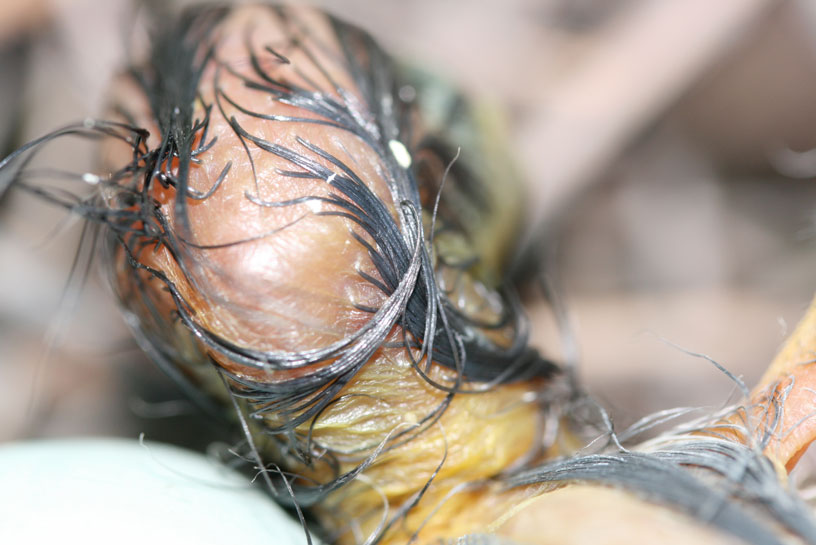


Don't you just love the back of a baby's neck?


Over the next day and a half, five healthy babies got the job done. The nest was full of naked, wet, transparent hatchlings. If you looked into a baby stroller and saw these babies, you might have to choke out the words, “What a beautiful child!” but they were beautiful to me and to their mother.


During the first week, the Naked Five turned into a ball of fluff. It was hard to imagine they would be fully mature in 4 weeks. A few days after hatching, 5 yellow swords appeared in the pile of squirming feathers.


And on the seventh day––they arose.


Tomorrow: Those difficult teen weeks.

Wednesday, March 16, 2011

SIT A SPELL

If I walked away from this place with a million bucks and a yellow, 4-WS ’88 Prelude, the most valuable thing I’d take with me is the ability to sit still.

By nature I run, even from the car to the grocery store. I love to run. In the past, I’ve been busy from sunup to sunset, like those tourists who bolt from the car, run to the rim of the Grand Canyon, look down, and run back to the car. “Check off the Grand Canyon, Evelyn!” That’s how most of us travel and sadly, how we live.

Sitting in my kayak for hours on end, I’ve learned to sit still and let  the world come to me. It brings me sights, sounds, and experiences that I would have trampled if I were still on the move.

Look a little closer, sit a little longer.

I had looked at the tangle of willow trees on the far bank of our pond for days and not seen anything unusual. But I looked one more time, and this time a large bird was scurrying along the shore, partially hidden. I saw just enough to make me say out loud, “That! is! a! penguin!” Seeing penguins is one of the Diagnostic Criteria for Commitment in Iowa County. That evening, I risked mentioning the sighting to my husband. He’s been down this road a few times. He smiled.

The Ioway Penguin
 You know those color blindness tests in which a hidden object emerges as you pay more attention? Well, for the record, when a Green Heron squats close to the ground, subsuming her long legs, she is indeed shaped a lot like a penguin. How many Greenies had I paddled by over the years as I kayaked? If I hadn’t been sitting still, an entire world would have remained unknown to me.

Look a little closer,  sit a little longer.


If you row up to a row of painted turtles a log, they will bail overboard one by one. If you cruise the pond slowly day after day and coast up to them so slowly you’re barely moving, they will give you the benefit of the doubt. And if you do this all summer? They may allow you to place a hand on their shell.


Look a little closer,  sit a little longer.


I have one particular memento that reminds me to sit still, be patient, and pay attention. It was just another bullfrog photo, but I was playing around and zoomed in on the eye. I hoped to see some interesting details––little froggie rods and cones, perhaps. What I saw was––me! In my kayak taking his picture. Reflected in his eye.


Kayaker in a frog's eye


Frog-eye cheat sheet


 I looked back at other old pictures, and there I was in quite a few eyes. Then my husband looked at my favorite photo of our grandson. Wallah! Reflected in his big, blue eye was the photographer, his Nonna.

Look and look again. You might see a penguin or get a frog’s eye view of yourself. But first you will have to


Look a little closer, sit a little longer.


Tuesday, March 15, 2011

WALKIN’ ON THE WATER

There are animals that live in the water, and others that live inside the actual surface layer. And then there are the bugs who travel on top. Why is it that a pin-brained insect can rip right by my kayak and get across the pond in seconds––sans boat and paddle? 


Water striders create one of my favorite images in nature: a dent in the water. If you think that’s ho-hum, go make a dent in some water and then rejoin us. A dent is aesthetically beautiful––the slope, the shadow. It also is beautiful physics. It’s fascinating to dissect how something can stay on top of the water: the weight of the beast pushes down through its feet; the determination of water molecules to stick together creates pressure upwards from the surface; and the insect's feet have a built-in tendency to repel water. A drop of oil is hydrophobic, and so are water strider feet.

Just standing there on the pond is a complex situation, but these fellows also move and pretty darn fast at that. Movement adds all kinds of new physics issues. Suppose you were lucky enough to have feet that repelled water, and you found yourself standing out there in my pond. Now what? If you start to move, I bet you sink. Not so the strider. His little feet create these whorls or vortices; the water is thrust backwards, and he is propelled forward.

This is all plenty cool enough for me, but it gets even cooler. You may remember looking at liquid in a test tube and noticing that it doesn’t meet the glass at a right angle; it slopes upwards a bit at the edge. The word meniscus is burbling up through your cerebral cortex right now, I bet. When the strider gets to the edge of the water, he faces a climb up a watery hill, but that’s a story for another day.

I am amazed at what it takes for a bug of negligible weight to stroll on my pond. Imagine my surprise when I learned about the Basilisk or Jesus Lizard who runs on the water. Or Pygmy Geckos. Check out the links below to see these beasts defy gravity.

By way of contrast, one lovely afternoon my husband and my kayak did a barrel roll in the pond, providing an excellent demonstration of the limits of surface tension.


To see the Basilisk––and believe me, you want to see this––check out this video:
http://video.search.yahoo.com/search/video?p=basilisks+lizards+walk+on+water

To see Pygmy Geckos:
http://www.youtube.com/watch?v=pimZMS-B4dQ

To see human guys trying to walk on water:
http://videogoneviral.com/2010/05/guys-who-walk-on-water/