Tuesday, April 26, 2011


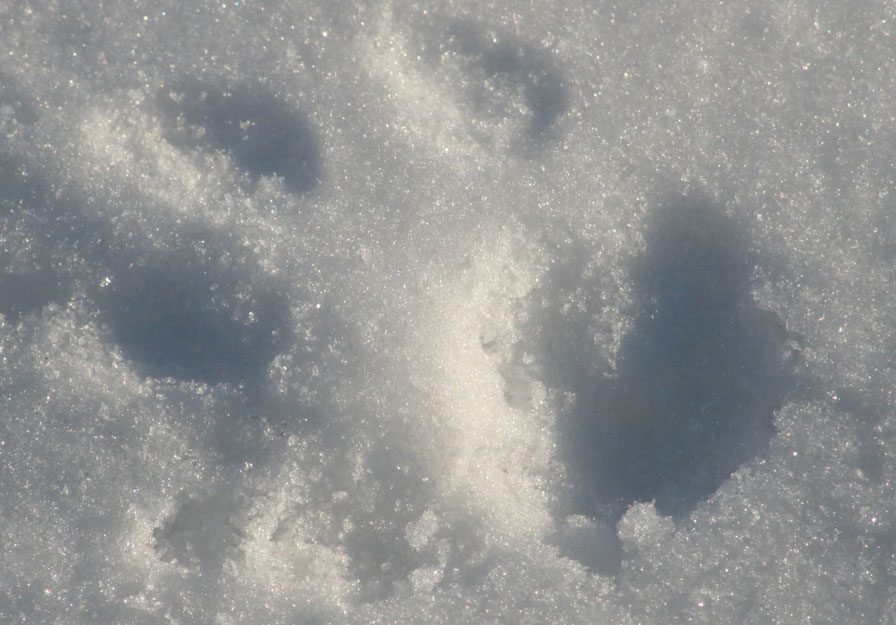
       FOOTSTEPS    

I am grateful for the gifts bestowed by the countryside, but it’s important to acknowledge that I don’t always return the favor.

Some good comes of intruding on nature, of poking one’s nose into nests and pools and even the occasional tryst.  If you share your adventures, you may remind others to value the wilderness and care for it. If you notice problems, you might be able to repair them and even prevent others.

But our very presence does damage. It disrupts animals. It transports seeds and plants to places they may do harm. It may actually maim and kill.

Fences can be deadly. Two taut wires twisted around a fawn’s leg held her tight. We wanted to help her, but she was scared to death of us. She screamed and kicked and thrashed. Eventually we freed her, but her leg was dislocated. She ran amazingly fast on 3 legs and disappeared beyond the pond. The vet said the leg might snap back into place, but I think he was being kind. Fences are not one of man’s greatest inventions if you’re a wild animal.

Yesterday I watched a painted turtle up in the woods. She was pawing at the ground, so I figured she was covering her eggs. I watched for half an hour. When I walked closer, I saw that she was caught in a fence and was struggling to get free. I pried her loose, happy she wasn’t a snapper. If someone hadn’t put in that fence a century ago, it would never have happened. On the other hand if I hadn’t been walking in the woods, she would still be there.

Our fields had always been mowed by local farmers. We let them go wild, and the very next year, ground-nesters returned like magic. Dickcissels and meadowlarks sang their hearts out. But when I mow walking paths through the deep grasses, I also mow snakes, butterflies, and even a frog or two. Not a good feeling.

You can make planks out of our weeds out here. I was hacking at some scrub bushes that were too close to the house.   I cut a branch and just one second too late saw a warbler nest. I tried to prop it up but mama left the area.

You can’t really know the impact you have. It’s easy to step on turtle eggs or baby mice and never know it. It’s easy to distress a rabbit when you don’t even know you’re standing by her babies.

Nature takes balance. I enjoy it, notice it, learn about it. Respect it. Repair it. But I also know that not every creature is thrilled to see me coming.

Monday, April 25, 2011

                                  LAST STOP
                                O              O      
                                         
As beautiful as the countryside is, there is a relentless effort to trash it. On almost every farm, there are wonderful ravines full of old cars and washing machines. Rusted out farm machinery fills rolling pastures. Trees grow through abandoned tractor windows. One nearby gulley is filled with twisted metal, an old mobile home long since buried and grown over. One summer a fox raised her kits in a cave under its corrugated side panel.

In the field behind us there was an old school bus. It was buried in the ground up to the bottom step. There’s no access to that field, and it’s a good half-mile off the road. I have no idea how it got to its final resting place.


Our little seven-year old friend spotted that bus in an instant. We set out through the marsh. When we stepped inside, it was clear someone had actually lived in there. It had a refrigerator, chairs, dishes, old bus seats, and broken glass throughout. The arrangement had to be the result of a rollover.


This was a little boy’s dream. He sat in the moss covered driver’s seat and turned the huge steering wheel. He shifted, checked the gauges, pulled knobs. He stood on top of the bus, king of the swamp.

Turns out the bottom field wasn’t the final resting place for that bus. One day it simply disappeared. It didn’t sink into the earth like the cow did. (See entry for 2/22.)  It would have taken a crane to lift it, but the crane would have to be airlifted in. I believe I’d have noticed that. And the bus was such a rust-bucket that surely it would fall to pieces under its own weight. The more obvious question, of course, is who wanted that pile of rubble? This carjacker must have been smoking pokeweed.

A few weeks later I was driving along a country road and spotted the bus in a farmyard 2 miles away. It was above ground, but it didn’t look any better. That bus did not need restoring; it needed resurrecting. If they get ‘er done, it will be the triumph of hope over impossibility. 

Sunday, April 24, 2011

IT’S A BIRD!


 IT’S A - BIRD?
Do you look at a 737 and wonder how it’s possible to get such a thing up in the air? The wild turkey has even worse aerodynamic qualities. My old dog, Obe, once stepped on a turkey in the field. It screamed and took to the air, and that’s putting it generously. It lumbered into the air, heading for the woods. Turkeys are very slow to achieve a cruising altitude, and Obe grabbed its foot a couple of times. It escaped to see another turkey season.


You’d hope that if you can’t run fast or get off the ground efficiently, you’d be extra smart. Turkeys, consider the dinosaur. Heed the brain-to-body size issue.

We have wilderness all around us, but one turkey laid her eggs right by the house. I knew our dogs would use those turkey babies (poults) for dog treats.


So here I go again, this time building a turkey preserve. (See Feb. 23 entry.) I dragged a fence out there and staked it. It had to be quite large; turkeys have a wingspan of 5-6 feet. But I was realistic-with a brain the size of a chestnut, we weren't going to have any precision landings in that pen. She abandoned her eggs. One of them still sits by our Haviland china.


The Song of the Turkey is never going to catch on, either. Their gobbling sounds like they’re falling down stairs.

So-not great flyers, not great singers. No grip whatsoever on location, location, location. Good thing they’re attractive; well, good thing they're unusual.

Turkeys have both waddles and snoods. (Sounds like a country duo from the 60s, doesn't it?) Take the waddle. It’s a chunk of tissue that hangs below the beak. It’s also called a dewlap. And a caruncle. Everything about this bird is unattractive, even its parts list. Even weirder is the turkey snood. That’s the nasty-looking piece of skin that hangs from the bird’s forehead, waving in front of its eyes. It’s a cockscomb, and it’s used as a garnish in France. In a cream sauce. With turkey or chicken kidneys. Honest. The turkey may not be too bright or graceful, but unlike people in France, you would never ever see one eating creamed snood.


To see songs about turkeys:

To hear a turkey sing:
http://www.allaboutbirds.org/guide/Wild_Turkey/id